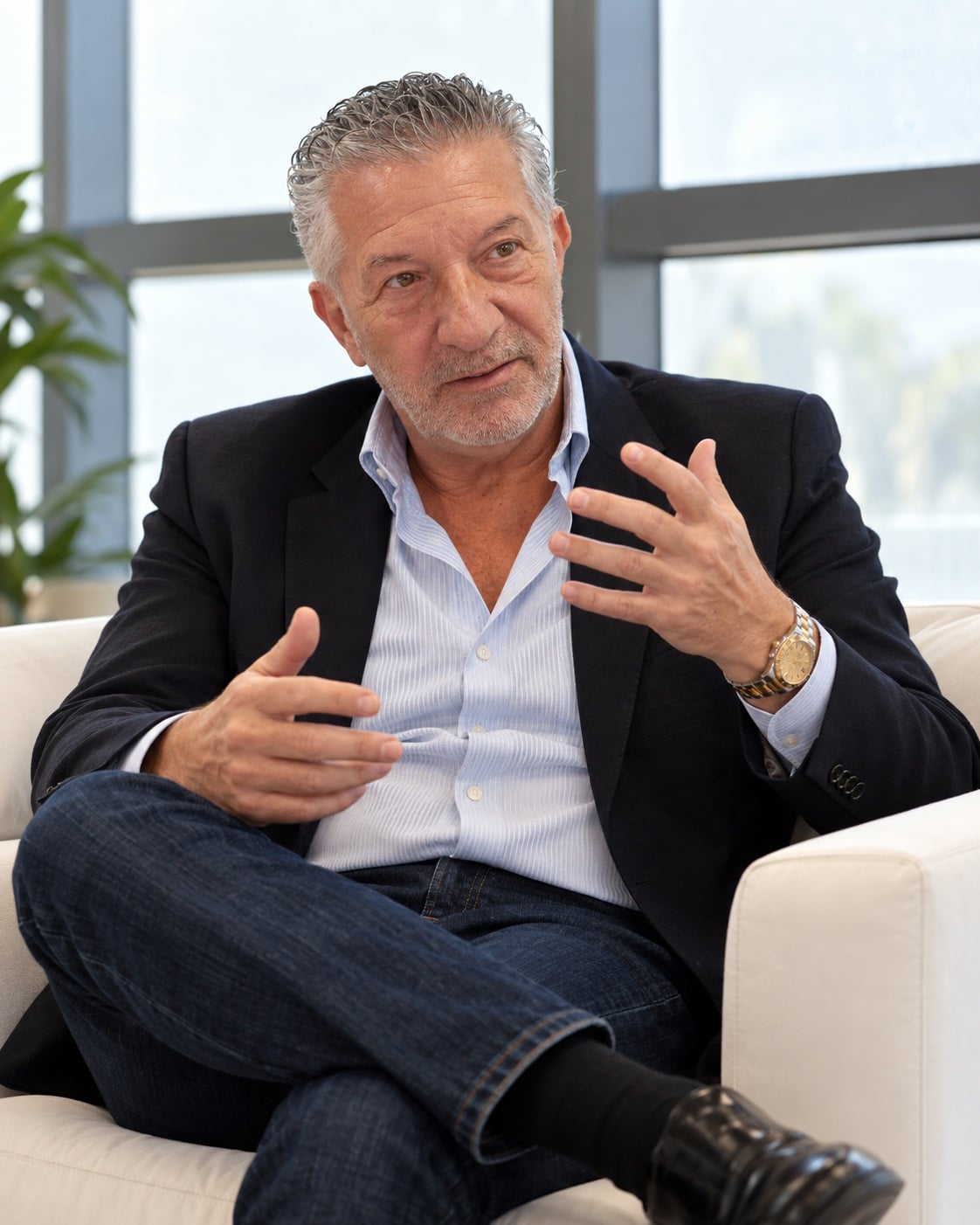
By KC Cuijpers, CEO, Town & Country Property Co., Ltd.
I never studied how to become a realtor. Perhaps that was a good thing. I am in my sixties now. I am certainly not Generation Z or a Millennial, and my son Chester still has to rescue me when the Smart TV at home decides it no longer wants to connect to the Wi-Fi. So no, I am not going to pretend that I understand everything about the modern world, haha.
I was actually a dropout at school. How I later managed to graduate Cum Laude in Hotel Management remains something of a miracle to me. But I have always been adventurous, creative and commercially minded. Years in hospitality teach you something very important: service. Listen to people, understand what they actually want, treat them fairly and hopefully make them come back.
Long before Town & Country Property existed, I was already buying and selling my own homes in Holland. I had to, because my career regularly moved me from one part of the country to another. Without really knowing there was a professional term for it, I started staging my properties. Improve them, present them properly, make them attractive, make somebody walking through the front door want to live there. Every property sold, usually quickly and with a profit. I was never stuck with one. Perhaps my real estate education had already started without me knowing it.
Property was never my first career
My working life went through quite a few stages. I started at the bottom, including washing dishes, moved through hospitality, marketing and sales, eventually became sales director of one of Holland's largest meat wholesalers, ran a multi-million enterprise called Fresh Partners and, shortly before moving to Thailand, reorganised the logistics and production operation of New York Pizza in the Netherlands.
One of the partners in New York Pizza eventually asked me to come to Thailand. That is how I landed here at 35 years old. The first project was not property at all. It was an upmarket Grand Cafe called Samsara on Pattaya Beach Road. After Samsara was sold to Tricon International, I moved into consultancy and advisory work. Before long, that turned into turnkey contracting as well. Funny really. First I told people what I thought they should do. Then they asked me to actually do it.
Through my relationship with the Srifuengfung family I became involved around Horseshoe Point and the Riding Academy. I knew absolutely nothing about horses, but apparently I understood how to sell the experience around them. Then property started entering the picture: The Residence at Horseshoe Point, The Village at Horseshoe Point, involvement around Grange Park and the early SP developments. Town & Country Property followed in June 2003.
Since then, property has been part of my life almost every day. TCP did not only sell other people's developments. We developed our own, including The Meadows, The Residence Jomtien and Whispering Palms. We carried out turnkey projects. We advised developers. We watched projects succeed, struggle, reinvent themselves and sometimes make mistakes.
Even today, much of my life still revolves around discussing projects. I remain closely involved as an advisor with people behind Sunplay, Ocean View Estate and Sunrise Estate in Bangsaray, and regular dinners with developer friends inevitably turn into conversations about land, design, buyers, pricing, new concepts and how we can improve things. And, equally important, which wine we should order, haha.
So when somebody asks me about houses for sale in Pattaya, I do not only look at a house through the eyes of an estate agent. I look at it as somebody who has bought properties himself, sold them, developed them, renovated them, marketed them, advised on them and watched people live in them. That changes the questions you ask.
First question: why do you want a house?
This may sound almost too simple, but I want to know why you want to buy. Permanent home? Retirement? Holiday home? Investment? Family with children? Dogs? Golf? Garden? Privacy? Close to nightlife? Close to an international school? Near the motorway because you regularly travel to Bangkok? There is no best house in Pattaya. There is only a house that is right or wrong for you.
A spectacular five-bedroom pool villa may be completely wrong for somebody who spends eight months of the year overseas. A smaller home inside a properly managed estate may be far more practical. Somebody with three large dogs probably has very different priorities from somebody who wants to lock the front door and fly back to Europe for three months.
I try to understand how a buyer actually lives, not how they imagine themselves living while walking through a beautiful show villa on a Saturday afternoon. That difference can save a lot of money.
Pattaya is much bigger than people think
One of the biggest mistakes first-time buyers make is talking about Pattaya as if it were one small property market. It is not. Pattaya has become a substantial city and lifestyles can change completely within a 15-minute drive. If you want a condominium and city lifestyle, Central Pattaya, Jomtien, Pratumnak or Wongamat may immediately come into the discussion. But when somebody specifically wants a house, my map becomes different.
East Pattaya
Cross Sukhumvit Road and everything changes surprisingly quickly. East Pattaya has traditionally been where many of Pattaya's real permanent residents live: families, business owners, people with regular jobs, long-term foreign residents and Thai families. Land is less expensive than close to the coastline, so you generally receive much more space for your money. There are countless gated communities, private houses, family homes and pool villas. For somebody who wants normal day-to-day living rather than a holiday atmosphere, East Pattaya is often the logical starting point.
Mabprachan
Mabprachan has developed into something quite different. Larger land plots, serious pool villas, attractive gated estates, international schools nearby, motorway access and golf courses all around you. Twenty years ago people sometimes spoke about Mabprachan as if it were somewhere in the countryside. Today it has become one of Pattaya's established higher-end residential areas, and some of the most impressive homes in Greater Pattaya are located there.
Huay Yai
I also like Huay Yai. It is greener, quieter and far less densely built. There is no real centre, but connectivity is excellent and new residential communities continue appearing. It is particularly interesting for people who want space or perhaps want to create something themselves. We recently listed one of the most impressive private designer homes I have seen during my entire TCP career in Huay Yai. That would have been difficult to imagine there 15 or 20 years ago. Times change.
Jomtien and Na Jomtien
People occasionally walk into our office and say: 'I want a beachfront villa in Jomtien.' Fine. So would half of Pattaya. The reality is that prime beachfront land is extremely valuable and true beachfront houses are scarce. There are excellent villas and residential communities around Jomtien and Na Jomtien, but buyers need realistic expectations about location, land size and price. The closer you want to be to the sea and central city conveniences, the more expensive land becomes and the less house you generally receive for the same money.
Bangsaray
And then there is Bangsaray. People who know me already know I have a soft spot for it. More greenery, lower density, beaches, seafood, a genuine local community and an almost upcountry feeling while remaining connected to Pattaya and the Eastern Seaboard. With Sunplay, Ocean View and other developments appearing over the years, Bangsaray has gradually attracted a more sophisticated residential market as well. For somebody looking five or ten years ahead rather than only at what exists today, I find the area very interesting. That does not mean everybody should buy there. It means everybody should understand the alternatives before deciding.
New house or resale?
I have no preference for new simply because it is new. A new villa has obvious attractions: modern layout, new materials, contemporary kitchen, nice bathrooms, perhaps smart-home systems and no previous owner drilling mysterious holes into every wall. But new developments also need investigating. Who is the developer? What have they completed before? What exactly is included? Is the beautiful show house standard specification or has another THB 3 million quietly been added to make it look fantastic? Swimming pool included? Landscaping? Curtains? Air-conditioning? Kitchen appliances? Furniture? Lighting? There can be a substantial difference between the house in the brochure and the house delivered to you.
Resale has advantages too. The estate already exists. The neighbours exist. The trees have grown. You can see how well the development has been maintained. And Thailand has probably already thrown a few rainy seasons at it. That is useful information. Sometimes an older property in a very good location, bought correctly and renovated properly, represents far better value than the latest shiny development. New is not automatically better. Old is not automatically cheaper. Look at the actual property.
Gated community or independent house?
Another important decision. A good gated community gives security, controlled surroundings, common-area maintenance and sometimes facilities such as a clubhouse, swimming pool or fitness room. There will usually also be rules. Those rules may occasionally irritate you, but they can protect the overall appearance and value of the estate. The neighbour cannot necessarily paint his house fluorescent orange or convert his front garden into a motorbike repair business. That has value.
An independent house gives much more freedom, but with freedom comes responsibility. Who maintains the road? Who controls drainage? Where does wastewater go? Is the access road legally secure? Who handles security? What happens if the vacant land next door suddenly becomes a commercial building? Neither option is automatically better. Again: it depends on you.
If you build, start with the land
I love seeing buyers create their own home. But I always say the same thing. Do not start with Pinterest. Start with the land. People fall in love with a house design and then try to force it onto the wrong plot. The land determines much more than people realise: access, levels, orientation, drainage, privacy, neighbours, future development around you and eventually resale. You can redesign a house. You cannot move the land underneath it.
Foreign buyers: understand what you are actually buying
This is the part where nobody should become creative. A foreign buyer can buy a house in Thailand, but the house and the land underneath it are two different legal questions. Foreigners generally cannot simply put Thai land into their personal foreign name. There are very limited statutory exceptions, but for the overwhelming majority of foreign house buyers those exceptions are not the practical route. So the ownership structure needs proper thought.
Leasehold may suit some people. Registered rights such as superficies or usufruct may be relevant in certain cases. A genuine Thai company conducting legitimate business is one thing. Using Thai shareholders purely as nominees to disguise foreign ownership of land is something completely different. Please do not accept 'everybody does it' as a legal opinion. And please do not automatically assume that a renewable 30-year lease means 60 or 90 years of guaranteed ownership. Thirty years means thirty years unless and until another legal step actually occurs.
We have written extensively about these subjects because they deserve far more explanation than I can responsibly squeeze into one paragraph. My advice is simple. Before you pay serious money, have your own independent Thai lawyer explain exactly what you will own, what you will not own and what happens when you eventually want to sell, leave, inherit or transfer it. Not the developer's lawyer. Not the seller's lawyer. Yours.
A beautiful kitchen does not cure a bad title
When people view houses they naturally look at the things they understand: kitchen, bathrooms, swimming pool, furniture, garden. Fantastic. I look at those too. But somebody also needs to look at the boring things. Who owns the land? What title deed is involved? Are there mortgages or registered rights? Is the access road legally secured? Do the land boundaries correspond with reality? Does the building legally exist as represented? Have substantial additions been made? Who actually has authority to sell?
If a company owns the property, then you do not only investigate the house. You investigate the company. Accounts, shareholders, liabilities, taxes, corporate documents and history all suddenly matter. You can replace an ugly sofa tomorrow. Fixing a bad legal structure is considerably less enjoyable.
And please inspect the actual house
This also surprises me occasionally. Somebody will negotiate THB 200,000 off the price of a THB 20 million villa and feel extremely proud. Then they do not want to spend a modest amount having the property professionally inspected. Wrong saving. Look at roof condition, electrical systems, water pressure, plumbing, air-conditioning, pumps, pool equipment, waterproofing, cracks, termites and drainage. Especially drainage.
This is Thailand. Rain occasionally comes down as if somebody upstairs forgot to close the tap. Ask what happens after several hours of heavy rain. Has the house flooded? Has the road flooded? Where does the water actually go? Do not ask only the seller. Ask the neighbours. Neighbours are wonderful sources of information. Sometimes too wonderful, haha.
You can renovate almost everything except the neighbours
This is one of my favourite rules. Kitchen? Change it. Bathrooms? Change them. Swimming pool? Renovate it. Garden? Start again. Neighbour from hell? Good luck.
Look over the walls. Drive through the neighbourhood at different times. Come back at night. Come on a weekend. Listen. Smell. Look at parking. Look at dogs. Look at businesses operating nearby. And never assume that the beautiful empty field behind your pool will remain beautiful and empty forever. Find out what can be built there. A sea view or green view that does not belong to you is not guaranteed simply because the estate agent photographed it.
What will the house REALLY cost you?
The asking price is only the opening number. A THB 10 million property that needs a new kitchen, bathrooms, curtains, furniture, landscaping, pool renovation and air-conditioning may very quickly become a THB 13 million property. That does not necessarily make it a bad purchase. But calculate honestly.
Then calculate the ongoing cost: estate charges, swimming pool, garden, repairs, insurance, pest control, electricity, water, perhaps staff, perhaps company accounting and compliance where a genuine corporate structure is involved. Then come the transaction costs and taxes, which depend on the structure and seller circumstances. Have these calculated before you commit. Do not buy a THB 10 million house simply because you have THB 10 million. After you receive the keys, life continues.
Asking price and market value are not the same thing
Anybody can advertise a house for THB 30 million. I could advertise my coffee mug for THB 1 million this afternoon. That does not establish its market value. We compare. What else is for sale? What has actually sold? How long has the property been available? Land size? Location? Build quality? Age? Condition? Developer? Estate? Legal structure? What would it cost to reproduce? How much renovation does it need? How easy will it eventually be to sell?
Sometimes a buyer knowingly pays slightly above what I consider fair market value because they absolutely love the property. That is perfectly acceptable. A home is not only a spreadsheet. Just understand what you are doing.
If you are buying for rental, think like the tenant
Do not calculate rental income by asking what you personally would pay. Who is the tenant? A family with children attending an international school? Executive working on the Eastern Seaboard? Retired couple? Long-term foreign resident? Holiday visitor? Different houses suit completely different rental markets.
Look at real achievable rent, not optimistic advertised rent. Then deduct reality: vacancy, management, pool, garden, repairs, furniture replacement, air-conditioning servicing and agent commission. Gross rent is not net profit. And whenever somebody guarantees me some beautifully rounded return without discussing expenses, I become interested for all the wrong reasons. Buy the income. Not the PowerPoint presentation.
Think about selling before you buy
This sounds strange to some clients. 'KC, I haven't even bought the bloody house yet and you're talking about selling it.' Correct. Because one day you probably will. Maybe in two years. Maybe in twenty. Your family changes. Health changes. Relationships change. Financial circumstances change. Thailand changes.
Who is the next buyer? Would another foreigner understand your legal structure? Would a Thai family want the house? Is the design extremely personal? Is it massively overbuilt compared with everything around it? Is it in a location that appeals only to a tiny group of people? Can the next buyer obtain a clean transaction? Resale should be considered before purchase, not when you desperately need to sell.
Infrastructure is upside, not an excuse
I am extremely positive about Pattaya's long-term future. The Eastern Seaboard continues developing. U-Tapao will become increasingly important. Road connectivity continues improving. And one day, although it may take a while, I believe Pattaya will finally get proper public mass transportation. When that happens, this city will change again. I have said it before: Pattaya has the potential to become the Miami of the East.
But do not buy a bad property today because somebody promises a fantastic railway, airport, shopping centre or motorway tomorrow. The house should make sense today. Future infrastructure is the bonus.
Sometimes the best house to buy is no house at all
Years ago a Swedish gentleman walked into our office. He had arrived in Thailand the day before. First visit ever. He wanted to buy a guesthouse. Budget: approximately THB 35 million. I could easily have spent the next three days driving him around Pattaya trying to earn a commission. Instead I told him to enjoy Pattaya for a week or two and come back if he still wanted to buy a guesthouse afterwards. He never came back. Perfect result.
Sometimes the biggest risk is not the property. It is the buyer making a major decision before understanding where he is. There is nothing wrong with renting first. Walk around. Drive around. Eat there. Sit in traffic. Experience rainy season. See whether the area you fell in love with on holiday still feels right three months later. A good estate agent should sometimes be capable of saying: Not yet.
What I want answered before you pay a reservation
By the time a client pays a reservation, I do not want us starting the thinking process. I want most of the thinking already finished. Do you genuinely like the house, or only the decoration? Does the location fit your real life? What exactly are you buying legally? Who owns the land? Who owns the building? Is access secured? What restrictions exist inside the estate? What happens when it rains? Who are the neighbours? What needs replacing? What will the complete property really cost you? What are the monthly running costs? Who could rent it? Who could eventually buy it from you? Has your own lawyer checked the legal side?
If the answer to an important question is, 'Don't worry, this is Thailand,' please worry.
What 23 years really taught me
I have never believed that being a good property advisor is about having the biggest database. Technology can build enormous databases. AI can probably describe 500 villas before I finish my first coffee. Experience does something else.
After enough years you start recognising patterns. You have seen the project that looked fantastic and became fantastic. You have also seen the project that looked fantastic and never became anything. You know when a price feels wrong. You notice when a developer does not answer simple questions. You recognise a road that will become a problem. You see when a house has been designed by somebody who understands how people live and when it has simply been designed to photograph well.
You also learn that people are more important than property. Clients remember whether you advised them properly long after they forget what your commission was. I am an old vehicle these days. But very well maintained, haha. And in a business based largely on experience, knowledge and trust, age is not necessarily a disadvantage. Sometimes it is precisely what you are paying for.
So when you search online for houses for sale in Pattaya, enjoy the photographs. Make your shortlist. Fall in love with a swimming pool if you want to. Property should be enjoyable. But before transferring your money, look beyond the swimming pool. Understand the house. Understand the land. Understand the location. Understand the legal structure. Understand the real costs. Understand your exit.
Then ask yourself one final question: If I knew everything I know now, would I still buy this house? If the answer is yes, wonderful. Now we can start talking seriously.
About the author
KC Cuijpers is CEO of Town & Country Property Co., Ltd., established in Pattaya in 2003. His background spans hospitality, sales, business management, consulting, contracting, property development and more than two decades of residential and investment property on Thailand's Eastern Seaboard. TCP has been involved in developments including The Meadows, The Residence Jomtien and Whispering Palms, alongside advisory, sales, rental and commercial property assignments across Pattaya, Jomtien and Bangsaray.
This article reflects personal property-market experience and general information. It is not legal, tax or investment advice. Property ownership and transaction structures should always be reviewed by suitably qualified independent professionals for the specific circumstances involved.