By KC Cuijpers, CEO, Town & Country Property Co., Ltd.
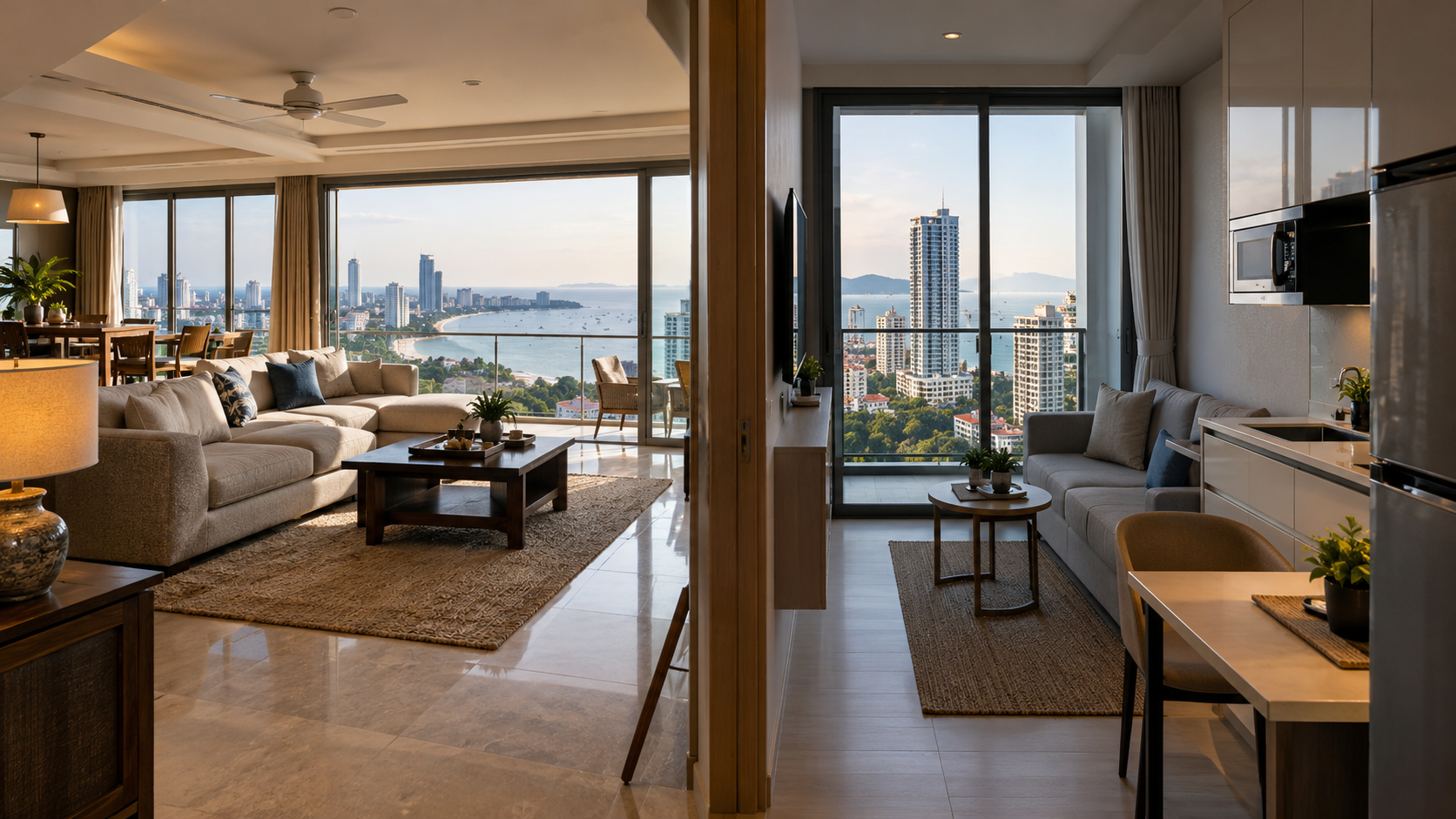
When we started Town & Country Property in Pattaya in 2003, the property market was a completely different world.
The British pound was worth close to 70 Thai baht, young British buyers were arriving in considerable numbers, and properties were selling like hot cakes.
Some of the sales boys were making astonishing amounts of money. Everybody seemed to be buying, selling, building or planning something.
And the general feeling?
This party might never end.
I was still something of a freshman in real estate myself, although I had already spent years in hospitality, consultancy and contracting.
Looking back, those early years were extraordinary. Pattaya was growing, confidence was high, and there was always another condominium project around the corner.
Literally.
A good friend called Rony
One of the people who played an important part in my early property career was Rony Fineman, the man behind Nova Group and somebody who became one of my closest friends.
Our relationship developed through business, particularly our involvement with Jameson's Irish Pub at Nova Park, where Town & Country handled the development, design execution and construction management.
That was around 2004 and 2005, when TCP was still heavily involved in turnkey contracting.
During those years, we were also moving into residential development ourselves, with projects including The Meadows, The Residence Jomtien and Whispering Palms. Together, they eventually delivered approximately 125 residential homes and units.
Meanwhile, Rony was building his own property empire.
One of his earlier condominium developments was Nova Mirage in Wongamat, completed in 2007. Town & Country sold a substantial number of units there, and I like to believe we helped give the project some early sales momentum.
But what I remember particularly well is how often Rony and I would discuss property concepts.
Not just prices and commissions.
Layouts, room sizes, construction costs, buyer preferences, hotel operations, marketing and rental potential.
We were constantly brainstorming.
Sometimes those conversations were probably more interesting than the actual business meetings.
A five-star hotel room and a rather clever idea
At some point I suggested to Rony that we should spend a weekend in one of Bangkok's newest five-star hotels.
Not necessarily for a holiday.
I wanted to study how the hotel industry managed to create such comfortable, luxurious accommodation within relatively limited floor areas.
After all, hotel designers are experts at using space.
A well-designed hotel room might have a king-size bed, seating, workspace, storage, a beautiful bathroom and every modern convenience, all within an impressively compact footprint.
And yet it feels luxurious.
So why couldn't condominium developers apply some of the same principles?
Smarter layouts. Less wasted space. Better use of furniture. More efficient bathrooms and kitchens.
From a developer's perspective, the mathematics were attractive.
Reduce the square metres, reduce the total selling price, and suddenly your property becomes affordable to a much larger audience.
And provided the construction costs and selling prices worked in your favour, the developer could still make a healthy profit.
Everybody wins.
Or so we thought.
Welcome to your glamorous 25-square-metre lifestyle!
Over the following years, Pattaya's condominium market changed dramatically.
Developers became increasingly creative in squeezing more apartments into their projects.
Studios became smaller. One-bedroom apartments became smaller. Kitchens became compact little corners, sometimes hardly deserving the name.
And suddenly the market was advertising glamorous one-bedroom condominiums measuring approximately 25 square metres.
Twenty-five!
Welcome to your luxurious tropical lifestyle. Beautiful swimming pool, impressive lobby, fantastic fitness centre, rooftop lounge and, somewhere upstairs, your very own shoe box.
Haha.
Now, before somebody accuses me of being against smaller condominiums, let me explain something.
I am not.
There is absolutely nothing wrong with a cleverly designed compact apartment.
For a single person, a holiday visitor, a young professional or an investor targeting rental income, a small condominium can make perfect commercial sense.
Not everybody needs 150 square metres, three bedrooms and a huge terrace.
The problem begins when developers start confusing efficient living with simply making everything smaller.
There is a difference.
And I sometimes wonder whether those early conversations Rony and I had about smarter layouts helped encourage a trend that eventually went rather further than either of us had imagined.
I certainly wouldn't claim we invented small condominiums.
But we understood the commercial logic, and we were discussing it well before tiny apartments became such a familiar part of Pattaya's property landscape.
Want something new, modern AND spacious? Good luck!
Here is something that increasingly bothers me.
Suppose you are looking for a beautiful, modern condominium in Pattaya. You want a reputable development, attractive facilities, good management, a decent location and, preferably, something relatively new.
Nothing unreasonable about that.
And you would like a proper-sized apartment.
Perhaps a comfortable one-bedroom of 70 or 80 square metres, or a spacious two-bedroom of 120 square metres or more.
Well, good luck!
Looking at Pattaya's new condominium developments, it sometimes feels as though nine out of ten have decided that smaller is better.
Studios, compact one-bedrooms, slightly less compact one-bedrooms and the occasional two-bedroom that might once have qualified as a generous studio.
Of course, there are exceptions, including some excellent larger apartments and penthouses in newer developments.
But the actual choice available to buyers who want something genuinely spacious, modern and reasonably priced has become surprisingly limited.
And that creates a dilemma.
The older condominiums have the space. But do you want to live there?
Quite a few of Pattaya's older condominium developments offer wonderfully generous floor areas.
Large living rooms, proper bedrooms, separate kitchens, spacious balconies and enough storage to accommodate something more than two suitcases.
Some are beautifully maintained, well managed and remain excellent places to live.
Others? Well, perhaps not quite so attractive.
The location may no longer be what you want. The building might be showing its age. Facilities may be outdated. Management might leave something to be desired.
Or perhaps the development simply isn't particularly popular anymore.
And don't forget the budget.
A spacious apartment in a prime location, even in an older building, can still command a serious asking price, particularly if it has been beautifully renovated.
So now you have a choice.
A shiny new condominium with fantastic facilities but a relatively small apartment?
Or a much older building offering the space you want, but perhaps not the location, facilities, management or overall living environment you had hoped for?
Suddenly buying a nice condominium becomes rather more complicated than the developer's glossy brochure would suggest.
And I am not convinced that building another thousand compact apartments is necessarily the answer.
The buyer buys a lifestyle. The developer sells square metres.
Here is where I believe the industry sometimes lost its way.
Developers naturally calculate what they can build, how many units they can sell, and at what price.
Buyers, however, are supposed to be buying a home.
Those are not always the same thing.
A beautiful showroom can make a compact apartment look fantastic.
Every piece of furniture is perfectly positioned. Nothing is out of place. The lighting is wonderful. The curtains are open. Perhaps there is a spectacular view.
And naturally, there are no suitcases lying around, no ironing board, no shopping bags, no golf clubs, no dog bed and no collection of shoes that somebody refuses to throw away.
Try living there for six months.
With your partner.
Perhaps with a pet.
Suddenly those clever 25 square metres might not feel quite so clever anymore.
And the spectacular rooftop swimming pool doesn't help very much when you cannot find somewhere to put your vacuum cleaner.
I have always believed that a property should first work as a home. Whether somebody subsequently wants to rent it out, resell it or use it for holidays is another matter.
And a beautiful swimming pool downstairs does not make your bedroom any bigger.
But who am I to tell you how to live?
Now, having said all this, I should probably remind myself of something important.
It isn't my decision. It's yours.
Nobody knows better than you what kind of lifestyle you want.
Perhaps you spend most of your time outdoors, travel frequently, enjoy restaurants and nightlife, and hardly ever cook at home.
Then a compact modern condominium with excellent facilities could be absolutely perfect.
Why pay for space you never use?
On the other hand, perhaps you spend most evenings at home, enjoy cooking, entertain friends, work from home, have children or pets, or simply enjoy stretching out on a comfortable sofa with absolutely nothing planned for the evening.
Your priorities will be completely different.
And your financial limitations, future objectives, location preferences and personal circumstances matter just as much.
There is no universal definition of comfortable living.
I can explain the advantages and disadvantages. I can show you what your budget will buy. I can tell you which buildings I personally like and which ones I would approach with caution.
But ultimately, you are the one who will be living there.
Not me.
And I certainly don't intend to come and sit on your sofa to find out whether you've made the right choice.
Unless, of course, you invite me for a glass of wine.
Bigger isn't always better either
Of course, the opposite extreme is not necessarily sensible.
I have seen enormous apartments with terrible layouts, ridiculous corridors, wasted corners and oversized rooms that serve absolutely no purpose.
I have also seen relatively compact homes that feel spacious, comfortable and perfectly practical.
Good design matters far more than simply adding square metres.
What concerns me is when marketing takes priority over living.
Developers have become exceptionally good at selling the dream. Infinity pools, rooftop gardens, lounges, gyms, impressive entrance halls and beautifully staged photographs.
Nothing wrong with any of that.
But personally, I would like to see equal attention given to the space where people actually spend most of their time.
Their homes.
Does the bedroom accommodate a proper bed with room to walk around it? Is there sufficient storage? Can two people cook together? Is there somewhere comfortable to sit?
And perhaps most importantly, would somebody genuinely enjoy living there?
Not for a weekend.
For years.
Would I develop another condominium today?
Having been involved in developing our own residential projects, I know that creating a successful development involves considerably more than drawing a floor plan and selling the units.
Infrastructure, landscaping, construction quality, management, maintenance and the eventual living experience are all part of the equation.
I actually still live in The Meadows, one of our own residential developments, nearly twenty years after moving there.
Perhaps that explains some of my thinking.
Today, if I were to become involved in another residential development, I certainly wouldn't choose another high-density resort-style condominium filled predominantly with tiny apartments.
My preference would be something quite different.
Lower density. More greenery. Proper-sized bedrooms. Decent kitchens. Storage. Parking. Outdoor living space.
Real homes for real people.
Bangsaray, south of Pattaya, is one area where I believe there could be interesting opportunities for this type of residential development, provided the planning, infrastructure, economics and ownership structures make sense.
I would rather create something that people genuinely enjoy living in than another project that looks spectacular in a brochure but disappoints once the furniture arrives.
What 23 years have taught me
I don't regret those early years.
Quite the opposite.
They were exciting, enormously educational and commercially rewarding.
I made great friends, worked with some very creative developers, learned from our own projects and watched Pattaya grow into a much more sophisticated property market.
But I have also learned that every development trend eventually needs to be questioned.
Smaller units made sense.
Better layouts made sense.
Making property more affordable made sense.
But somewhere along the way, parts of the industry became a little too enthusiastic about squeezing every last saleable square metre out of a building.
And that's the funny thing about property.
You can reduce the size of an apartment on a drawing.
You can reduce the construction cost.
You can reduce the selling price.
But you cannot reduce the amount of space people need to live comfortably.
How much space that actually means is entirely up to you.
After all, it's your money, your lifestyle and your sofa.
Make sure you can enjoy all three.
KC Cuijpers
CEO, Town & Country Property Co., Ltd.
Pattaya, Thailand
Established 2003